Published
Feb 2, 2026
4
min

Increasing pressure from South Africa’s ever-growing Quick Service Restaurant sector has bled into hiring practices where speed overshadows standardised processes over hiring the best person for a role. JOBJACK’s QSR customers show how challenging this industry mindset is by hiring for FIT, building better retention and long-term success.
South Africa's quick-service restaurant sector is one of the largest and most dynamic segments in the country's retail economy. It is also under real pressure: Margin compression, intensifying competition and a value-obsessed consumer base have shone a spotlight on the highest operational cost across the industry: the wage bill.
The market is estimated at R1,110 billion, growing at a more modest 3–5% year on year, even as footfall in some segments has started to decline.
To support the scale of the sector, you need the right people: Around 150 recognised QSR brands and more than 10,000 corporate and franchise outlets operate across the country, employing close to 220,000 people in formal roles alone. For a large share of South Africa's youth, these store-level roles remain a crucial first point of entry into formal employment.
The QSR hiring paradox: When speed becomes the cost
South Africa's QSR recruitment dynamics are influenced by conditions few global hiring models need to account for. Severe high youth unemployment drives enormous application volumes into a relatively small number of open roles.
Varying sourcing methods, ranging from WhatsApp, referrals, walk-ins and career days to build talent benches, form the starting point of a lot of QSR’s “free” recruitment methodology.
From discussions with QSR stores, standardised screening is rare. Considering their sourcing methods, what QSR may gain in free candidate interest, they pay for with large-scale manual sorting and limited proximity, transport reliability, shift availability, and basic customer service aptitude, with the decision made on gut feel and necessity. Overall, speed is still valued over a candidate's fit for the role.
Yet despite the volume, the industry is always hiring. Annual employee turnover at a store level regularly exceeds 70%, impacting the customer experience due to the operational strain, raising the question: If you're constantly hiring to replace the people who have just left, are you really hiring faster or simply hiring more often?
The repercussions of short-term, speed-first store hiring
Internal impact
Priorising speed for the sake of just making a hire as quickly as possible comes at the cost of standardised processes that are intentional about who you hire.
The strain shows up in two places within a business:
HR and hiring management are stuck on a treadmill where speed consistently overshadows governance. Store hiring managers face a persistent gap between speed and competency, often without any consistent standard applied across the group. The result is no unified hiring DNA at the store level; two stores running identical operating systems can have completely different hiring criteria that show up in the customer experience.
Operations is forced to absorb the downstream cost. An unfilled shift means lost upsell during peak trade hours, stretched staff, and overtime. Store managers end up eating into the wage-to-sales ratio targets. Managers are tied up recruiting instead of running the store itself.
The customer impact
Public review data from two separate locations of a well-known international burger brand operating in South Africa showcase the direct impact on customers’ experience.
At the first location, a sample of the first 40 reviews (out of 5,384 total, averaging 3.6 stars) showed staff-related complaints in 37.5% of the reviews, against just 10% mentioning staff positively. Customers described being ignored mid-complaint, spoken over, or dismissed outright.
At the second location, a sample of the first 40 reviews (out of 1,483 total, averaging 4.0 stars) told a different story: staff were mentioned positively more often than negatively, 25% against 20%. One reviewer described the team as "very efficient and an amazing team."
The same brand with the same menu produces vastly different experiences.
In a market where consumers are already deciding where their shrinking spend goes, the store-level experience should not be overlooked, and it is directly tied to who you hire.
Fit-Based hiring: What 18 months of data from QSR stores using JOBJACK shows
By creating a solution that understands how the retail and QSR industries source, JOBJACK fit-based hiring engine allows stores to centralise their recruitment into a platform based ATS that standardises process and is fuelled by fit-based hiring technology called JobFIT™.
JobFIT™ enables store managers to measure a candidate’s potential to perform well in a store specific role by looking at fit signals like psychometric assessment results, location radiums, previous work experience and additional screening elements, all in real-time.
From the data
Across 20 multi-brand, multi-store QSR groups hiring through the JOBJACK platform, we looked back at 18 months of hiring activity.
The scale alone tells its own story: 2.5 million applications against just 10,500 jobs posted, resulting in 7,500 appointments. That works out to close to 238 applications per position posted at a successful application-to-hire rate of well under 1%. This is the applicant volume problem the sector lives with every day.
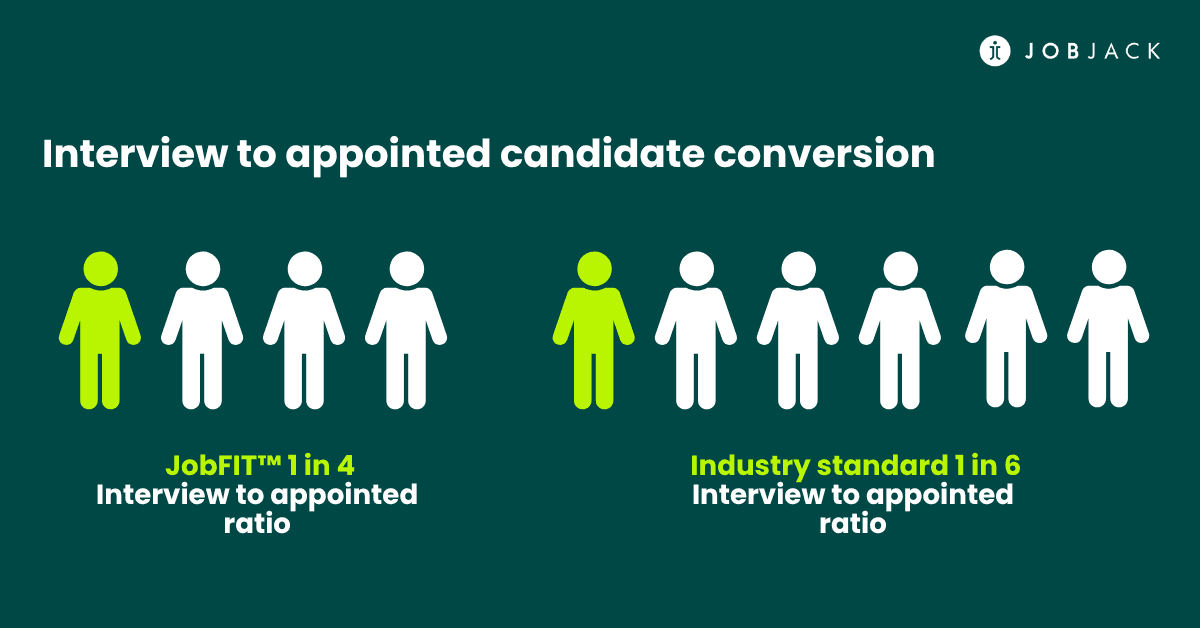
Positively, 81% of jobs were successfully filled. More notably, JobFIT™'s ability to assess and rank candidates by their fit for a role produced a 26.79% interview-to-appointment rate, one in four interviews converted to a hire versus an industry norm closer to one in six.
Of the 27,975 interviews held across the period, 18.65% of candidates who were promising but did not get hired were placed on the hiring waitlist. These candidates have already been screened, assessed, ranked by JobFIT™, and interviewed. By being held in a waitlist or talent bank, a store manager has the ability to extend an offer directly the next time a role opens without going through the process again, ultimately increasing their time to hire.
What changes the equation is a fit-based approach applied consistently, access to data for strategic planning across a full store portfolio, a growing bench of pre-assessed talent, and operational continuity built on a hiring DNA that's set centrally but executed by store managers, who get both the ownership and the tools to hire right, onboard faster, and get new hires to productivity sooner.
None of this is about hiring faster for its own sake. It's about making the hire predictable enough that everything post-hire, from sales, customer experience, retention, succession and cost, becomes something the business can actually plan around.
Store-level hiring in South Africa's QSR sector isn't short on applicants. It's short on a reliable way to tell, quickly, which applicant will actually stay, succeed, and grow into the role. That's the gap fit-based hiring is built to close. It shouldn’t be simply to fill the next shift as quickly as possible, it should be to build a consistent workforce that keeps the business moving.
Next up
© 2026 JOBJACK. All rights reserved.